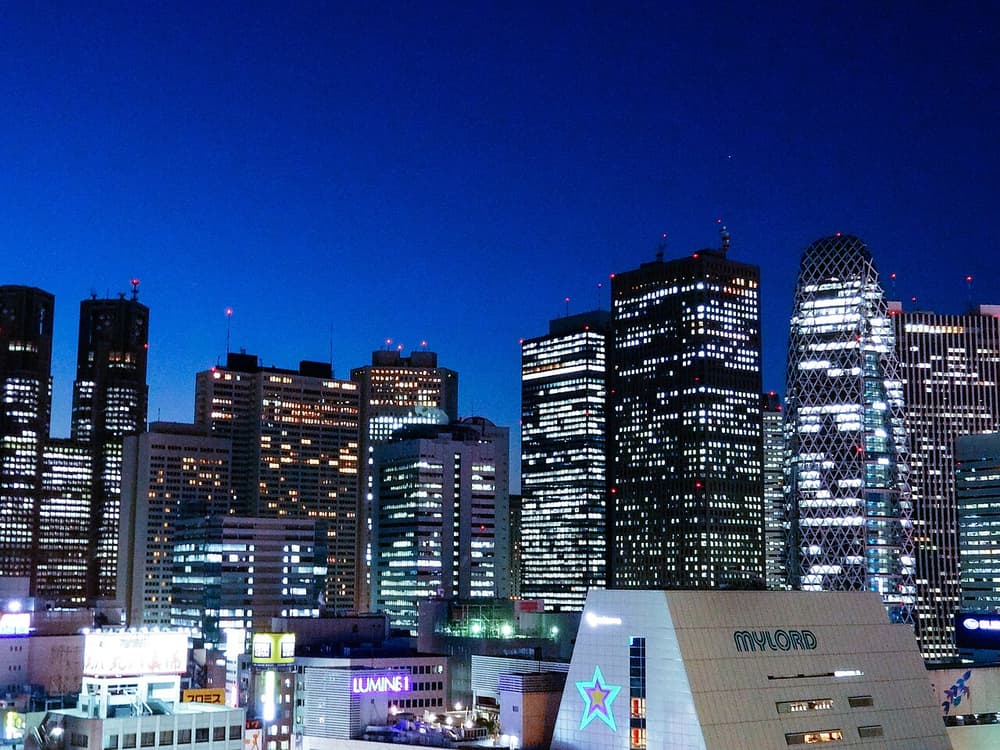
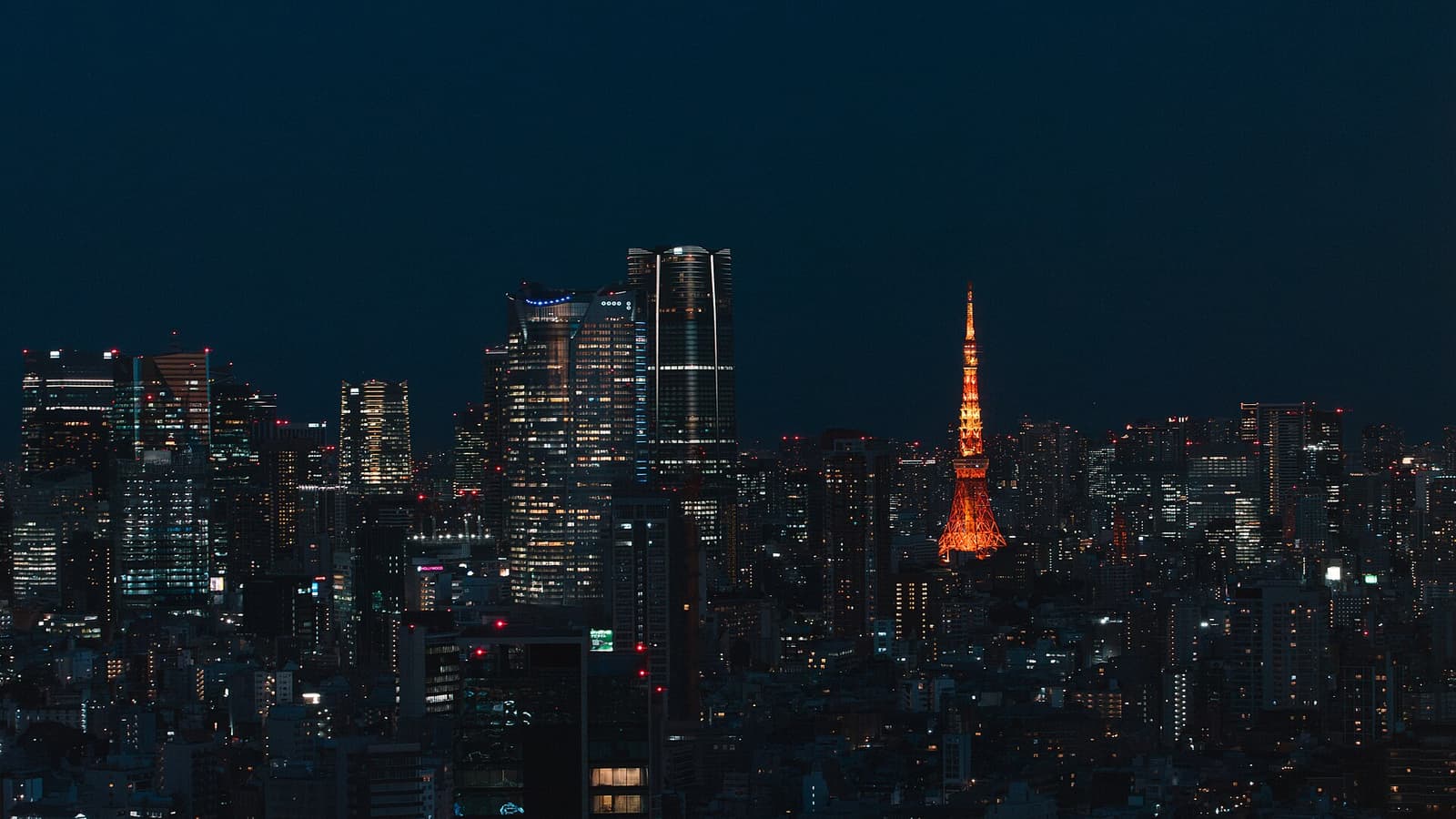
Park Hyatt Tokyo
The “Lost in Translation” hotel, high above Nishi-Shinjuku, with famously quiet rooms and the New York Bar on the top floor. Check its current status and rates before booking, as it has recently been renovated.

Tokyo has no single centre. Choose the district first — for its transport, its evenings and its price — then the hotel.
Almost any hotel near a station on the JR Yamanote loop or a main subway line will work, because trains are fast and frequent. The differences are in what you find outside the door at night, how far you are from the airport train, and what you pay. Rooms are smaller than in most countries: a standard double in a business hotel is often 13–18 square metres, so check the size before booking.
Prices swing widely. Late March to early April (cherry blossom), Golden Week, autumn weekends and the New Year period are the most expensive; January, February and June the cheapest. Book early for spring and autumn, and look at Asakusa, Ueno, Ikebukuro or Akihabara if Shinjuku and Shibuya are over budget.
Below, a comparison of the main areas, followed by hotels we have picked in each of our fifteen destinations for location and consistently good guest scores. For the day-trip destinations, an overnight stay — especially in a hot-spring ryokan in Hakone or at Lake Kawaguchiko — is one of the highlights of a trip to Japan.
Hotel links on this page go to Trip.com. We may earn a commission on bookings at no extra cost to you; it does not influence which hotels we list.
| Area | Best for | Drawbacks | Airport access |
|---|---|---|---|
| Shinjuku | First visits, nightlife, day trips to Fuji and Hakone | Crowded; the station is a maze; Kabukicho is noisy | Narita Express and limousine buses direct |
| Shibuya | Shopping, restaurants, younger travellers | Busy and loud until late; fewer budget hotels | Narita Express direct; easy from Haneda |
| Ginza & Tokyo Station | Central location, Shinkansen, refined dining | Higher prices; quiet at night | Narita Express, buses and monorail connection |
| Asakusa | Atmosphere, value, ryokan-style inns | 30 minutes or more from the west side | Direct trains from both airports |
| Ueno | Budget stays, museums, trips north | A little rough-edged by the station | Skyliner from Narita in about 41 minutes |
| Akihabara & Kanda | Central, good-value modern hotels | Little evening atmosphere once shops close | One change from either airport |
| Roppongi & Azabudai | Luxury hotels, art, international dining | Off the JR network; rowdy near the crossing | Limousine buses to major hotels |
| Odaiba | Families, bay views, Disney and Haneda access | Far from most sights; quiet evenings | Limousine buses; close to Haneda |
| Ikebukuro | Yamanote convenience on a budget | Fewer sights of its own | Limousine buses; Skyliner via Nippori |
Guest scores are Trip.com ratings out of 5, read in October 2026. We do not show prices because they change daily — every card links to live rates and availability.
Neon nights, tiny bars, a vast garden and Tokyo’s best-connected station.
The “Lost in Translation” hotel, high above Nishi-Shinjuku, with famously quiet rooms and the New York Bar on the top floor. Check its current status and rates before booking, as it has recently been renovated.
A large, dependable west-side classic a few minutes from the station, with airport limousine buses at the door and a wide choice of room types and restaurants.
The hotel with the Godzilla head on its terrace, in the middle of Kabukicho. Compact modern rooms and the nightlife at your feet — light sleepers should ask for a high floor.
The Scramble Crossing, a rooftop in the sky, a shrine in a forest and Tokyo’s street fashion.
A long-established tower hotel on the hill just above the station, with wide views and a quieter setting than the streets around the crossing.
A modern hotel inside the Shibuya Stream complex, connected directly to the station and convenient for the Toyoko Line to Yokohama.
A design-led hotel above Miyashita Park, between Shibuya and Harajuku, with the rooftop park and its restaurants on the doorstep.
Tokyo’s oldest temple, lantern-lit shopping lanes, river boats and the tallest tower in Japan.
A stylish hotel directly beside Kaminarimon, known for its rooftop terrace and bar looking across to Skytree.
A large, long-established hotel on the west side of the temple district, with upper-floor views over Senso-ji and Skytree.
A full-service hotel in neighbouring Kinshicho with open views of Skytree, well placed for the tower and direct trains to Tokyo Station.
Elegant shopping streets, the Imperial Palace, Tsukiji’s food stalls and kabuki.
The grand hotel inside the red-brick Marunouchi station building itself — the most convenient address in Tokyo for the Shinkansen.
One of Japan’s most storied hotels, facing Hibiya Park between the palace and Ginza. It is being redeveloped in phases, so check which buildings are open.
A contemporary hotel a few steps from Kabuki-za and the Ginza 4-chome crossing, well placed for an early start at Tsukiji.
A good-value modern hotel in the back streets of Ginza, close to several subway lines.
Tokyo’s museum park, a boisterous market street and the old town that time forgot.
A design-conscious hotel between Ueno Station and the park that showcases local craftspeople, with a good restaurant and bicycles for guests.
A reliable modern hotel across the street from Ueno Station, handy for the Skyliner and the Ginza Line.
A straightforward, well-run hotel beside Keisei-Ueno Station and the entrance to the park — convenient for an early Skyliner to Narita.
Anime, games, arcades and electronics — with a 1,300-year-old shrine and a town of bookshops next door.
A stylish hotel a short walk from the station that champions local makers and music, with a restaurant and bar popular beyond its guests.
A compact modern hotel directly connected to JR Akihabara Station — hard to beat for convenience.
A calm, garden-themed hotel in the Kanda backstreets near Suidobashi, within reach of Jimbocho and Tokyo Dome.
Tokyo Tower, teamLab Borderless, art museums and skyline views from Japan’s tallest building district.
The flagship hotel of Roppongi Hills, steps from the Mori Art Museum, with a large spa and a long list of restaurants.
High in the Tokyo Midtown tower, with some of the most sweeping city and Mount Fuji views of any hotel in Tokyo.
A polished mid-range hotel between Roppongi Crossing and Roppongi-itchome, well placed for Azabudai Hills.
teamLab Planets, the tuna auction, a giant Gundam and Rainbow Bridge views across Tokyo Bay.
A grand bayfront hotel beside Daiba Station, with rooms looking over Rainbow Bridge or towards Haneda and the bay.
A resort-style hotel on the waterfront with balconies facing Rainbow Bridge and the Tokyo skyline, next to Aqua City.
Sunshine City, anime shopping, a ramen battleground and good-value hotels on the Yamanote Line.
A large, well-regarded hotel a few minutes from the station’s west exit, with airport limousine bus services and several restaurants.
A big tower hotel inside the Sunshine City complex itself — ideal for families visiting the aquarium, observatory and Pokémon Center.
An apartment-style hotel with kitchenettes and rooms for four or more, popular with families and groups.
Tokyo Disneyland and the one-of-a-kind DisneySea, 15 minutes by train from Tokyo Station.
The Victorian-style Disney hotel directly in front of the Tokyo Disneyland entrance, with character-themed rooms and the benefits reserved for Disney hotel guests.
A large official hotel on the monorail loop with spacious family rooms and bay views.
A family-focused hotel connected to Shin-Urayasu Station, one stop from Maihama, with shuttle buses to the parks and rooms designed for small children.
An official hotel on the monorail loop with resort-style grounds, pools in season and a wide range of room types.
Japan’s sacred peak from its finest viewpoints: Chureito Pagoda, Lake Kawaguchiko and Oshino Hakkai.
A traditional hot-spring hotel on the lake’s east shore, a short walk from the ropeway, with rooftop baths looking straight at Mount Fuji.
A hillside resort hotel above the lake whose rooms and open-air baths are oriented towards the mountain.
A historic lakeside hotel on the quieter south-west shore, set in large gardens known for their cherry blossom.
A full-service resort hotel beside Fuji-Q Highland in Fujiyoshida, with large hot-spring baths and close-up Fuji views.
Hot springs, a volcanic valley, a pirate ship on Lake Ashi and — with luck — Mount Fuji.
A landmark of Japanese hotel history in Miyanoshita, opened in 1878, blending Western and Japanese architecture; its guests have included writers, royalty and film stars.
A contemporary hot-spring hotel in Kowakidani in which every room has its own open-air bath, with infinity-style public baths facing the mountains.
A large, good-value hot-spring hotel in Hakone-Yumoto with many different baths, convenient for a first or last night.
Gilded World Heritage shrines in a cedar forest, with waterfalls and a mountain lake above.
Japan’s oldest classic resort hotel, opened in 1873 on the hill above Shinkyo Bridge — creaking floors, old-world dining room and a short walk to the shrines.
Its lakeside sister, a lodge-style hotel among the trees at Lake Chuzenji, with hot-spring baths and an away-from-it-all feel.
A luxury resort on the shore of Lake Chuzenji with hot-spring baths and views of Mount Nantai.
A comfortable hotel directly opposite JR Nikko Station, with its own hot-spring bath — the practical choice for a short stay.
The Great Buddha, Zen temples, a seaside tram and an island shrine — an hour from Tokyo.
A modern hotel a few steps from Kamakura Station’s east exit and Komachi-dori — the most convenient base for an early start at the temples.
A resort hotel on the hill above Shichirigahama beach, with sea-facing rooms and views towards Enoshima and Mount Fuji.
A relaxed, good-value hostel-style hotel close to Yuigahama beach, with private rooms as well as dormitories.
A harbour skyline, Japan’s biggest Chinatown, red-brick warehouses and a cup-noodle museum, 30 minutes from Tokyo.
The hotel on the upper floors of the Landmark Tower, among the highest rooms in Japan, with sweeping views of the harbour and, on clear days, Mount Fuji.
Yokohama’s grand old hotel, opened in 1927 facing Yamashita Park; its original building has hosted Charlie Chaplin and General MacArthur.
A recently opened hotel between Minato Mirai and Bashamichi, next to a large music arena and a short walk from the waterfront.
The sail-shaped landmark on the tip of Minato Mirai, with harbour views from almost every room.
Timed tickets for teamLab and Shibuya Sky sell out, sumo and food tours run in small groups, and the best Mount Fuji days fill up in sakura and autumn-leaf season. Compare the best-rated options and book in a couple of taps.
Shinjuku has more hotels at every price and better connections for day trips. Shibuya is more compact and fashionable, with easier access to Yokohama. Both are on the Yamanote Line, seven minutes apart.
Asakusa, Ueno and Ikebukuro generally offer the best value among well-connected districts, followed by Akihabara and Kanda.
For cherry-blossom season, Golden Week, autumn and New Year, three to six months ahead. At other times a few weeks is normally enough, though the best-value rooms go first.
If your schedule allows, yes. A night in a hot-spring ryokan is a highlight in itself, and staying over greatly improves your chances of seeing Mount Fuji clearly in the early morning.